
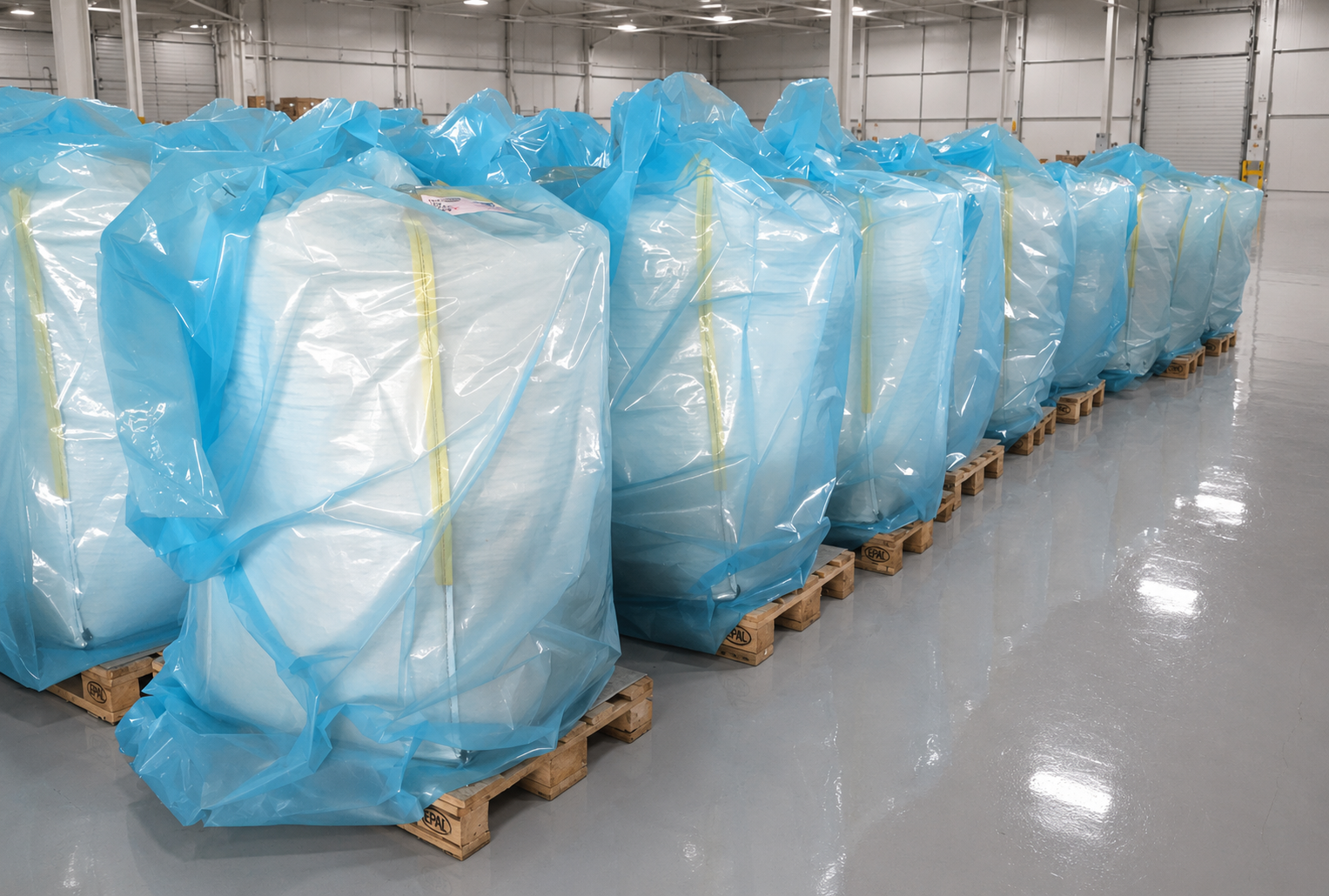
FIBC Wrapping Liners are high-barrier liners designed to enclose complete FIBCs or big bags while allowing the original bulk packaging to remain intact.
The liner is wrapped around the full FIBC and securely sealed. The integrated vQm Two-Way Valve provides one connection point for vacuuming and gas flushing with the vQm High-Speed or XL Conditioning Unit, allowing the atmosphere around the complete FIBC to be modified without opening or repacking the original big bag.
This makes the FIBC Wrapping Liner particularly suitable for incoming bulk goods that need to be isolated, treated or protected before storage or onward transport. Modified Atmosphere Packaging (MAP) conditions can be created around the complete FIBC, helping protect the product against external moisture ingress, oxidation, mould-related risks and stored-product insects during storage and transport.
For the modified atmosphere to reach and protect the product, the original FIBC or inner packaging must allow sufficient gas exchange. If an inner liner is already airtight, the MAP conditions will remain outside that liner and will not reach the product inside.
Once conditioned, the FIBC Wrapping Liner remains around the big bag to maintain the protective atmosphere during storage or onward transport. Additional outer protection must be applied where required to help prevent damage during transport.
The FIBC Wrapping Liners are manufactured in a BRC-certified food-grade production environment, supporting their use in packaging applications for food and agricultural commodities.
Treat or protect complete big bags without opening, transferring or repacking the product reducing additional handling while maintaining protection.
The high-barrier liner strongly limits moisture ingress, helping reduce rehydration, condensation-related damage and mould risk.
A low-oxygen atmosphere helps reduce oxidative quality deterioration during storage and transport.
Modified Atmosphere Packaging can be used to treat insects across all life stages in, using low-oxygen, CO₂-rich or N₂-rich atmospheres without conventional toxic fumigants. For applications specifically focused on insect treatment, please refer to our Non-chemical Insect Treatment page for requirements and further guidance.
Incoming FIBCs can be enclosed immediately for inspection or treatment, helping isolate potentially infested goods and reduce the risk of cross containment or external reinfestation.
An FIBC Wrapping Liner is a high-barrier enclosure designed to wrap around a complete big bag or FIBC, allowing the atmosphere around the original bulk packaging to be controlled without opening it.
No. The complete FIBC remains intact while the Wrapping Liner is sealed around it and conditioned. For the modified atmosphere to reach and protect the product, the original FIBC must allow sufficient gas exchange. If the FIBC is airtight, the MAP conditions will remain outside those packages and will not reach the product inside.
Yes, provided the original FIBC and any inner packaging allow sufficient gas exchange. The required treatment conditions depend on the target insect, product temperature, gas concentration and exposure time.
Yes, but if the existing inner liner is airtight, the modified atmosphere created outside it will not reach the product. The packaging configuration should therefore be assessed before treatment.
Yes, the Wrapping Liner can remain around the FIBC during transport, only if it is sufficiently protected with additional outer protection layer.
Yes, FIBC Wrapping Liners can be supplied in different dimensions to suit the size and shape of the big bag.
The integrated vQm Two-Way Valve is connected to a vQm Conditioning Unit, allowing air to be extracted and N₂, CO₂ or another selected gas composition to be introduced.
Yes, incoming FIBCs can be enclosed immediately to isolate the load before inspection, treatment or release into the warehouse. For applications specifically focused on insect treatment, please read the Non-chemical insect treatment page for requirements and further guidance.
Yes. The high-barrier construction strongly limits moisture ingress from the surrounding environment.
Yes, the appropriate unit depends on the FIBC volume, product characteristics and required conditioning process.
Create a modified atmosphere around full big bags while keeping the original FIBC intact.